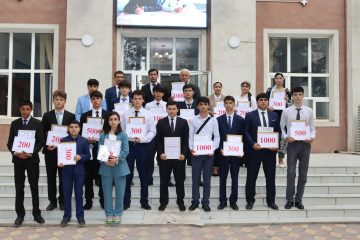
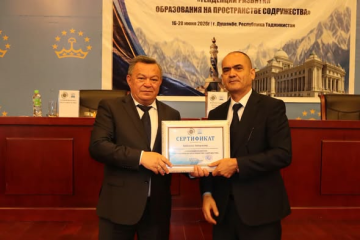
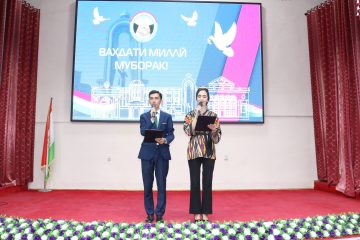
On May 8, 2026, according to the action plan of the Committee for Primary and Secondary Vocational Education under the Government of the Republic of Tajikistan, a scientific and practical conference entitled “Tajikistan’s Achievements During the Period of Independence: Reality and Prospects” dedicated to the 35th anniversary of the State Independence of the Republic of Tajikistan was held in the library hall of the Technical College of TTU named after Academician M. Osimi. The event was organized by the Department of Science and Innovation together with the Organizational and Educational Administration.
The conference was opened by the Deputy Director for Science and Innovation, Candidate of Technical Sciences, Associate Professor Azimov Kholiknazar, who congratulated the participants and noted that State Independence is the greatest and most sacred achievement of the Tajik nation, creating a solid foundation for the development of science, education, and modern technologies in the country.
It was noted that during the 35 years of Independence, thanks to the wise policy of the Founder of Peace and National Unity, Leader of the Nation, President of the Republic of Tajikistan, respected Emomali Rahmon, the material and technical base of educational institutions, including colleges, lyceums, technical institutes, and universities, has been completely modernized. Today, young people have the opportunity to engage in scientific research using modern technologies and digital libraries and to make a worthy contribution to the innovative development of the country.
Then, the Deputy Director for Educational Affairs, Safarov Ilhomjon, emphasized in his speech the important role of Independence in shaping the state youth policy and educating young people in the spirit of patriotism and national self-awareness. He noted that the youth of the Independence era are the builders of the present and future of beloved Tajikistan. It is precisely the youth-oriented policy of the respected Leader of the Nation, Emomali Rahmon, that has created conditions for the younger generation to occupy leading positions in various spheres of public life, including science, technology, and public administration. Safarov stressed that preserving these historic achievements and maintaining national unity is the sacred duty of every student and teacher of the college.
During the continuation of the event, the Head of the Department of Science and Innovation, Gulov Navruz, delivered a report on the progress in the field of science and the practical implementation of innovative projects by students and teachers of the college during the years of independence. He noted that in the modern world, science and innovation are the main driving forces of the national economy. It was precisely during the years of independence that the legislative and material-technical foundations of science in vocational education institutions were completely modernized.
Afterwards, the Head of the Department of Languages, Rahimzoda Bahodur, stated that the development of various sectors of the national economy, including industry, energy, and transport, directly depends on the level of training of highly qualified technical specialists. It was during the period of State Independence, thanks to the constructive initiatives of the Government of the country, that educational conditions in specialized departments of vocational educational institutions were brought closer to international standards.
At the same time, the Head of the Department of Humanities and Law, Azizmamadova Zulfiya, spoke about the legal foundations of Tajik national statehood and its historical values. She emphasized that Independence established a strong legal foundation for the country and contributed to the revival of national history and culture. The adoption of the Constitution of the Republic of Tajikistan as the destiny-defining document of the nation guaranteed human and civil rights and freedoms and determined the path toward the development of a democratic, law-based, and secular state.
In addition, the Head of the Library, Turdieva Mavjuda, spoke about the role of libraries in raising public awareness and creating modern reading conditions for the younger generation during this period. She noted that libraries, as centers of science and enlightenment, gained a special status during the Independence era. Thanks to the cultural policy of the country’s leadership, the college library is now supplied with new scientific, educational, and literary materials, and students are fully provided with access to digital libraries and the Internet.
At the conclusion of the conference, the participants discussed the issues raised and identified future tasks for the further development of the institution’s scientific and educational activities.